
Resident Evil Part 4: How Level Design Supports Tension
Level design in Resident Evil forces players to double back and open locked doors. The repetition supports tension

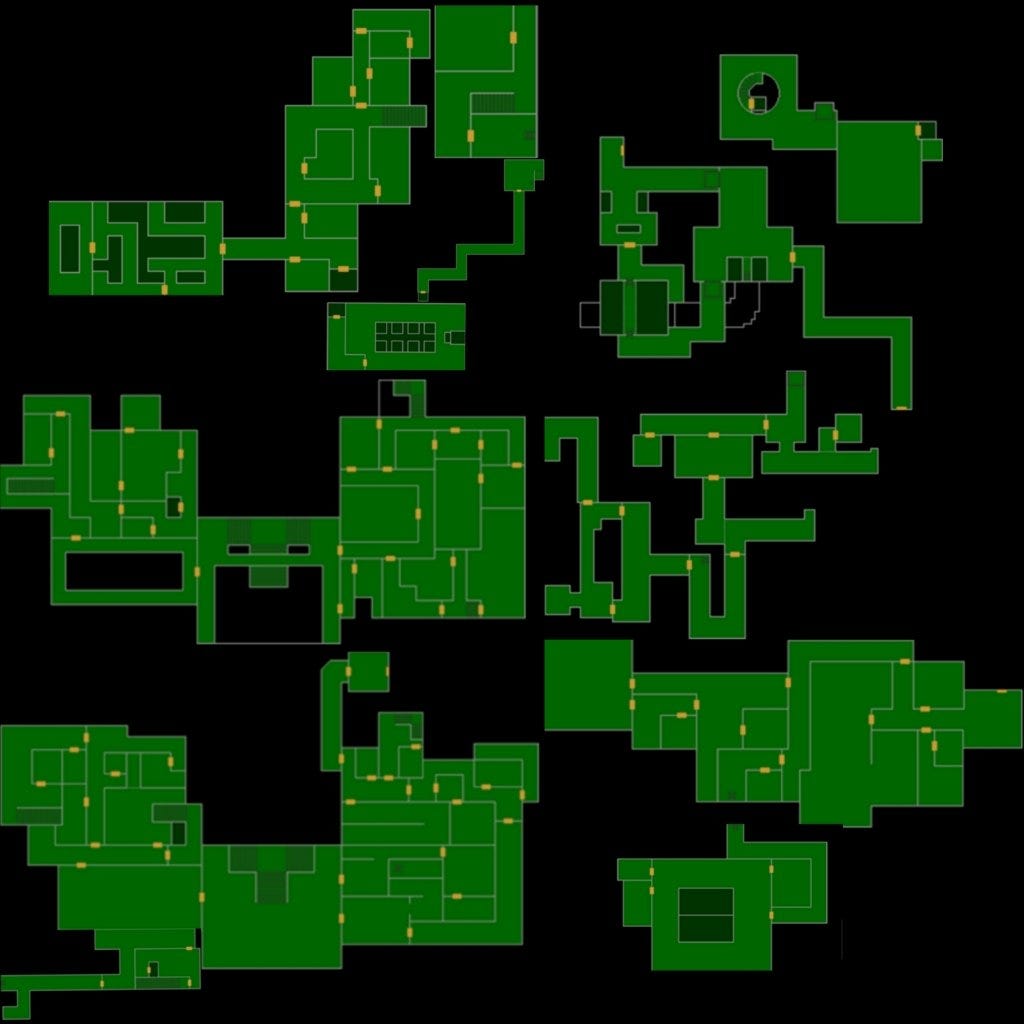
Confined Spaces (Resident Evil 1 Map)
Game Dev - Cameras: Resident Evil Design - Part 4 - As we walk around in the world, I’d venture few of us think much about how things are designed. The flow of traffic due to traffic lights, the positioning of escalators in any malls that remain, or the arrangement of amusement park attractions. The best designs draw our focus and move us in an intended direction. They make us do what the architect intends. Games are no different. In fact, I’d say they’re more intentional. Each space is leading the player or players toward a goal. It is affected by how much players can see on the screen, where the camera is in relation to the player, if/when camera control is taken from them, etc. Let’s look at how the Resident Evil team has designed spaces and used cameras over the years to build tension
Note: Before we get into this, I’d note we’ve already talked about art, narrative, and sound. If you missed those or want to read about them, please do
As with the other dissections of RE we’ll split into three eras. The first is the original era (RE1, 2, 3, Code: Veronica + RE0 and RE1: Remake). The second era (RE4-6), and the modern era (RE7-9 + RE2-4 remakes)
Being a horror game typically means restricting information from players. The more that’s hidden, the more unease it can bring. The original era games made good use of this. First, the spaces within the Spencer Mansion (RE1), Raccoon City Police Station (RE2-3), and island of Dr. Moreau (C:V) were mostly confined. Long hallways with blind corners, rooms without much *ahem* room, and the inevitable lab that followed the same design principles, but with more sterility
They also had something else… the fixed camera. You see kids, back in the 90s and early 2000s, games could save on memory using fixed cameras. Environments could remain pre-rendered 2D while the “action” could be 3D. This helped bypass hardware limitations
“Hold up. Stop right there. That belongs in a dissection of engineering or maybe art”
There was a side effect of the fixed camera. It created a lot of blind spots. So an L-shaped hallway might have 3-4 camera positions but none revealed the whole space. That means when those dogs come crashing through the windows in RE1, you only see one of them while the other is terrifyingly heard. Fixed cameras also let the audio team do it’s work. As mentioned in the audio breakdown, you could hear zombies around corners before you saw them. Of course, sometimes you didn’t and ended up lunch
Then there is the narrow FOV (field of view). This was mentioned before and is present in the second and modern eras. What this does is to make sure the player can never see that much. The standard FOV in games is about 90 degrees. In RE games it is 80-85 (or less). That 5 to 10 degree subtraction drastically changes what’s in view at any time. Don’t believe me? Get a protractor out, 2 pieces of paper, a headband, and lop off 5 degrees of vision from each side when you’re looking forward. Let’s see how that goes. Now, dim the lights and walk around your house with some people dressed like zombies waiting to grab you. Ok, that’d be intense regardless of the blinders
The lowered FOV hides information. That, again, serves to ratchet up tension. This is especially prevalent from RE4 on
Most of the games involve some degree of free exploration in a hub area with lots of backtracking, like a low key Metroidvania. They leave you with, “I found a new door… and it needs 3 hexagons to open. Who the hell designed this room of funhouse mirrors, anyway?
You might think it a bold, perhaps reckless decision, when Capcom ditched the fixed camera for the RE4 over-the-shoulder option. This change unofficially started the second era. Rather than talking about how that game was revolutionary, as it’s been done ad nauseum at this point, let’s look at what they did to not lose the tension that fixed camera provided. The fixed camera limited the player point of view, since you can only see what is presented. RE4 moved the camera to over-the-shoulder. This meant you could see what was in front of you. It also meant you cannot see what’s behind you. Now the FOV is tight in RE4… it’s been reported to be as low as 70,** which means there are 290 degrees that players cannot see. This keeps a large part of the environment blind
“Why does that matter?”
It matters because it fundamentally affects the level design. You can create big spaces with lots of enemies and routes for players to use. In doing this, however, you have to sacrifice blind corners. This is countered by flooding areas with enemies so the player has to keep moving else they get jumped from behind. This also means you can throw a mini-boss in the mix and the player must keep awareness of them at all times through sight and sound (the chainsaw guys in RE4, the axe guy in RE5, the giraffe in RE6 - iykyk). The camera changes in the second era definitively affected** level layouts. It also made the games from RE4-6 bend toward being more action heavy over the horror of the earlier games
The modern era evolved further. With RE7, the game moved, primarily, to a first person camera. The FOV (field of view) was reduced to that 80-85 degrees, meaning players can’t see as much. The first person camera lets players turn relatively quickly, so surroundings can be scanned. However, this also has brought back some pieces of the fixed camera age
“How does it do that? These things seem diametrically opposed?”
With a first person camera, as opposed to an over-the-shoulder 3rd person one, design can hide surprises. When the camera is over-the-shoulder, you can freely rotate the camera to check around corners and see things that were blind with a fixed camera. So the tighter FOV and first person camera allow the game to, in some ways, return to it’s horror roots while maintaining some feel of panicked action. RE9 is the case and point. It uses both the first person camera (for Grace sections) and over-the-shoulder (for Leon sections). It allows horror and action to live side by side in the same game
In terms of the levels themselves, each era thrives on confined spaces, outside of boss fights. Part of building tension in horror is not allowing players to simply run around a threat (though you could do that in the early RE games). If a hallway, walkway, or room is obstructed in multiple ways with a narrow path, that makes fluidity of movement substantially more difficult. In turn, the player is more vulnerable to attack
“Why did you spend so much time talking about FOV and cameras here?”
Because the camera is crucial in how levels are designed for any game. In the RE series they have evolved over the years in order to support the gameplay. First, with the fixed camera, then over-the-shoulder, and now first person (and over-the-shoulder). In the original era players had to navigate tight corridors with a fixed perspective. That meant lots of blind corners and places to get ambushed. In the second era the gameplay shifted to be more action oriented. So over-the-shoulder allowed for open spaces and more enemies to threaten at the same time, keeping the tension high. In the modern era the game returned to be more horror focused. That meant a switch to first person with a restricted FOV. Then claustrophobic level design could live again
“What about the remakes of RE2 and 3? They’re new and over-the-shoulder!”
They are. Multiple things played into making these games more tense. Even with the over-the-shoulder camera, they were able to build tension with claustrophobic spaces. Even if a space is larger, the player can’t run through much of it due to obstacles. Enemies, while never more than a handful, could come in through windows if they weren’t boarded up (which was new), and then the cat and mouse game with Mr. X or Nemesis kept anxiety high. The level design kept the over-the-shoulder from becoming too action oriented
Resident Evil is a rare franchise that’s allowed its camera and gameplay to evolve in interesting ways. Most games simply add a new power to a player’s inventory. It’d be hard to name games that have changed so much over the years, and still kept the core of what’s made them great. There is another company that has done this… but let’s leave Nintendo for another day