
Resident Evil: Part 1: Building Suspense
i.e. How Narrative Works in the Resident Evil series

Yikes
I’m about to make a controversial statement that will probably have some of you throw your hands in the air in resignation asking, “why do I continue to invest time reading this clown’s stuff? He clearly has no taste at all!” I’ve never been an anime fanboy. That might seem strange from a person who partially grew up in Japan. I don’t dislike it, but I also don’t love it. To me it’s like any other form of media. Some is good, some is garbage, most is bubblegum… <pause for effect>
Ok, now that the non-believers have left, we can get serious. Anime, at least the stuff I had access to, felt like the plot of a typical JRPG. You know the one, where the main character, an androgynous male seeks to save the world but doesn’t know if he has the inner strength to do so. Then there’s a love interest which typically seems too hard to attain. In the end he finds that inner strength, saves the world, and woos the special lady. Ok… clearly many are more complex than that, but we’re not here to talk about anime. Plus we lost all the Weebos in the first paragraph, so none of you care. Let’s get into our first part of the Resident Evil series
“Wait, you covered RE9 in the opening and you’re doing it again here”
Times are hard and we all have to make sacrifices
Here’s the thing with RE games. The narrative (plot, dialogue, themes, etc) has always skittered between memorable horror and goofy nonsense. It’s sort of like watching Evil Dead II, which is a great crossover between horror and comedy. In the case of RE however, the dev team likely thought what they were doing was cool, at least through RE6
Starting with the first game players are treated to a b-movie plot involving mysterious deaths in the woods outside Raccoon City (great name but better than Trash Panda City? You decide). There was a live action intro cinematic (worth watching). That intro was the beginning of survival horror and despite how it looks today, not one of us thought it cheesy in 1996
There’s a small cast of characters that survive the trip into the Spencer Mansion: Albert Wesker, Barry Burton, Chris Redfield (the overactor), Jill Valentine, and Rebecca Chambers. Jill and Chris are playable (as is Rebecca, briefly). They’re part of the S.T.A.R.S. Alpha team, a division of the Raccoon City PD sent to figure out what happened to S.T.A.R.S. Bravo team (why doesn’t anyone talk about the S.T.A.R.S. Charlie team? Never forget!) Yes, I know, Rebecca is part of Bravo Team. The manual had detailed bios of all of Alpha and Bravo team, so there was some backstory to those you come across
RE narratives are fairly overt. They mostly center around the Umbrella Corporation, a mega-corp, or offshoots/interested parties after its bankruptcy. Umbrella was founded by a James Markus (scientist), The Right Honorable Earl Ashford (virologist) and 5th Earl Ashford, and Oswald E. Spencer (British billionaire/eugenist). Spencer is an eccentric whose mansion servers as the location for the first game
Umbrella had its tentacles in everything. They have their own military force, employ double agents (ahem Wesker ahem), and bribe people from the police to the government. Raccoon City houses a facility that is doing research on the t-virus. No matter what the story is, their shadow is at the center of the events, even after the company’s disillusionment. While there are multiple other organizations, we’ll stick with Umbrella
“What is this, a recap of a 30 year old game? Isn’t there a wiki for this?”
Yes there is. Let’s talk about what works and why
The RE games are about creating suspense and panic. It’s a setup for a joke. The games are constantly priming and subverting expectations. Let’s look at an example everyone who played RE1 will remember. Early in the game players wander into a bedroom close to where they find the first zombie. There’s a book on the table they can read called The Keeper’s Diary. The diary which covers a timespan of about 10 days and entries become more disturbing, with the last two sealing the deal. “...Scott came. Ugly Face, so I killed him.” Then the final entry which reads, “Itchy, Tasty.” As soon as you put the diary down the wardrobe bursts open and The Keeper comes out trying to eat you. The tension built reading the pages of diary is paid off in that moment; it’s the punchline
The next thing that narrative design does is set up scenarios with the characters. Shortly before the first zombie encounter in RE1, Barry and Jill are examining blood on the ground in the dining hall. Barry says, “I hope it’s not Chris’ blood.” He then sends Jill off to explore where she quickly finds a zombie munching on Kenneth from Bravo team. Chris and Jill will remain separated until the end
Another moment is when you find Forest Spyer from Bravo team. Before you get to him there’s the cawing of crows (if you’ve been to Japan, this is a familiar sound). When you reach his body at the end of a balcony, you find he was pecked to death. In the original version of the game, the balcony is small and you see the body right away. In the RE1: Director’s Cut he comes alive and in the RE1: Remake the balcony is extended around a blind corner and he comes alive out of sight of the player. Again, subverting expectations and delivering a punchline
RE4 has an incredible intro where stakes are set and the game is quickly presented as being different from the earlier games. Leaving game design changes aside for now, from a narrative perspective, RE4 takes place outside the US and the zombies seem more sentient. I mean, they still immediately try to kill you when they see you, but it appears they could be playing cards in their downtime. When you arrive in the village, you’re quickly overcome with lots of angry Spaniards looking to end Leon’s life. Things reach a fevered pitch when the potato sack hooded chainsaw guy appears. Talk about ratcheting things up (Weirdly, if you didn’t go into a specific building in the original, he wouldn’t show up). After lots of fighting, running, and bouts with terror, the church bell rings. Everyone loses interest in Leon and head in the church
The church bell and obedient people paints a different picture than the mindless zombies of RE1 -> Code Veronica. The area is covered with spider-like insignias and paintings of a time when it seemed peaceful. These elements start to make it apparent that Leon is dealing with a cult and it wasn’t always this way
Then there’s RE9 where the zombies have personalities beyond being hungry. There’s a zombie type that has misophonia. If you, or anything, makes noise around it, the zombie will lose its mind and start violently attacking. The cleaning zombie reacts to messes created from blood splatter and starts compulsively cleaning. These little bits of narrative create personality for creatures that are otherwise devoid of such
All of these things enhance gameplay. Whether it be the setup of The Keeper’s room where the players back is to the closet only to have the doors burst open with The Keeper. In RE4 the chainsaw pushes the player out on the roof of the house, something you couldn’t do in prior games. In RE9 the zombie types can be exploited since player actions can cause them to reposition, attack each other, or otherwise do something that benefits the player (flick a switch and the OCD zombie will walk over and turn it off)
There is also the camp. The RE games follow a kind of grindhouse formula where they feel like low budget zombie flicks. Initially some dialogue was poorly translated resulting in amazing lines like, this one from Barry, “...And Jill, here’s a lockpick. It might be handy if you, the master of unlocking, take it with you.” (if she’s the “master of unlocking” shouldn’t she already have a lockpick?). Later Barry saves Jill from being crushed and delivers this gem, “You were almost a… Jill sandwich”
The lines start to become self-referential as a character in RE4 mentions she’s the “master of unlocking.” This continues through to RE9 where Leon is dropping one liners like he watched every Schwarzenegger movie and took copious notes. It’s clear, though, that the narrative team knows what’s funny about the earlier games and why
To close out we’ll look at plots and themes. Plots are what happens in each game and themes are greater ideas that sit across the games
The plot of each game is contained. They’re usually about surviving and escaping a location: RE1-3, 7, saving someone: RE4, 8-9, or infiltrating/stopping Umbrella or a shadow organization: Code Veronica, 5, 6
There are also themes that permeate the series and keep it relevant. A megacorporation that isn’t accountable to people or government. This fits in nicely with the conglomerates of Japan (ゾンビ企業). Mitsubishi makes cars, air conditions, cookware, heavy machinery, pharmaceuticals, and is Japan’s largest bank. You can look at it as commentary on that, or now the tech giants. Think of it as a bit of “big tech is watching you, but who’s watching big tech.” 30 years on companies and governments are a still a global cultural zeitgeist and source of suspicion (deservedly or not)
There’s also the inherent distrust many have of people of the elite that’s existed throughout history. A psychological phenomena we’re not going to get into, but it’s pervasive
Ultimately both are about power and ethics. Umbrella and its patrons are all powerful and ethically dubious looking to create bioweapons and control humanity. It lives in an area between fantasy/reality, distrust, and good vs evil
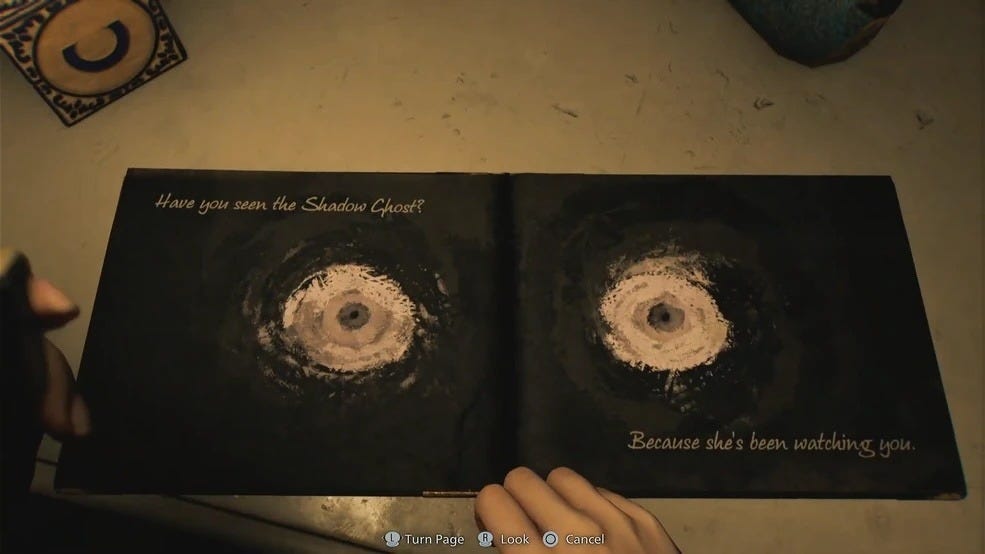
The narrative design in this series persists through its themes, easy plots, and twists and turns. It delivers set-ups that result in punchlines (in RE9 reading a book in the children’s room about the shadow ghost, only to be introduced to The Girl shortly afterwards - that’s called foreshadowing, people). It also brings camp that cuts the tension with awkward lines, a character that looks like DiCaprio in Code Veronica, and self deprecation. Are some of those moments accidental? Yes. Does it get into weird anime territory? Often. With the exception of a few bumps along the way, it remains true to form, a cheesy, b-movie series. Something that is part horror, occasionally funny, and almost always fun. The narrative hooks you from the intro of RE1 to every nonsensical character decision and puzzle
Note: There’s plenty of anime I like… but I’m not putting stickers on my car, nerds