player.gg

Search games

Publisher: Taito
Sort games
657 games
24 / 28
Densha de GO! Professional 2

Densha de GO! Professional 2

Taito GM R&D Sect. #2, Taito, Unbalance Corporation

Densha de Go! Professional-shiyou 2 (loosely translated to "Go by Train! Professional Specification 2") is an electric train driving simulation game developed and published by Taito for the PlayStation 2 in Japan on October 25, 2002. It was later ported to the PC by Unbalance on April 30, 2003. The sequel to the 1999 home console entry in the Densha De Go! series, Densha de Go! Professional-shiyou, Professional-shiyou 2 features a graphical upgrade and a new set of real-life train routes: the Shōnan-Shinjuku Line, the Tsurumi Line, the Kosei Line, the Seto-Ōhashi Line, and the Nagasaki Main Line to Sasebo Line. One new feature added to the series is the ability to save and resume route progress, and to start progress from a designated station.

Simulator
Densha de GO! 3 Tsuukinhen

Densha de GO! 3 Tsuukinhen

Taito GM R&D Sect. #2, Taito

Densha de Go! 3 Tsuukin-hen (loosely translated to "Go by Train! 3 Commuting Edition", also known as "Let's Go by Train! 3") is an electric train driving simulation game developed and released by Taito for arcades in Japan on March 2000. The sequel to the 1998 game Densha de Go! 2 Kousoku-hen, Densha de Go! 3 uses updated arcade hardware for improved 3D graphics (such as a higher-resolution user interface and improved models for both the trains and environment) while revamping the scoring calculation, adding online leaderboards, adding multiple time-of-day options (including morning, noon, evening, and night), and including two additional game modes ("Family Mode" for beginner players and "Tetsujin Mode" for advanced players). It features a new set of real-life train routes, including the Sasaguri Line, the Kagoshima Main Line, the San'yō Main Line, the San'in Main Line, the Chūō Main Line, and the Chūō-Sōbu Line. The game later received an update on October 2000, known as Densha de Go! 3 Tsuukin-hen: Daiya-kaisei (loosely translated to "Go by Train! 3 Commuting Edition: Diagram Revision"). This version updates some minor things, including the timetable and scoring calculation. It is the last arcade entry in the series in 14 years, prior to Densha de Go!! The original version was later ported to the PlayStation 2 on March 15, 2001, while the Daiya-kaisei version was later ported to the PC by Unbalance. The PS2 version also included a demo of Densha de Go! Shinkansen on a bonus disc, and later received a re-release (sans demo) as part of D3Publisher's Simple 2000 series of budget games, as Simple 2000 Series Vol. 22: The Tsuukin Densha Utenshi - Densha de Go! 3 Tsuukin-hen, on March 27, 2003.

Simulator
Densha de GO! Shinkansen: Sanyou Shinkansen-hen

Densha de GO! Shinkansen: Sanyou Shinkansen-hen

Taito GM R&D Sect. #2, Taito, Unbalance Corporation

Densha de Go! Shinkansen: Sanyoushinkansen-hen (loosely translated to "Go by Train! Shinkansen: Sanyou Shinkansen Edition") is an electric train driving simulation game developed and published by Taito for the PlayStation 2 in Japan on September 20, 2001. It was later ported to the PC by Unbalance on December 13, 2002. A spin-off of the Densha de Go! series, Shinkansen focuses on the titular high-speed rail line San'yō Shinkansen (through the entire route both ways, between Shin-Ōsaka and Hakata). The game was later ported to the Wii as Densha de Go! Shinkansen EX: Sanyoushinkansen-hen (loosely translated to "Go by Train! Shinkansen EX: Sanyou Shinkansen Edition") on March 1, 2007. This version features a new "Kids Mode" utilizing the Wii Remote's motion control.

Simulator
Battle Gear 4

Battle Gear 4

Taito

A driving simulator where by players race street legal cars on narrow Japanese speedways. The focus of the game is on manual shifting, drifting and quasi-legal driving tactics. When compared to the Battle Gear 3, there are certain features changed in this game. * The addition of European models (for example, Volkswagen Golf and Renault Clio (Lutecia) V6) and the European stages (with notable examples of the Monaco track and Monte Carlo Rally) representing a departure from Initial D. * The Takumi Mode in Battle Gear 3 is removed. Instead, a severe speed penalty is implemented into the system, forcing the player to use the brakes. * A more extensive tuning system is available to the key users. Instead of simply modding the external parts, the performance hardwares are available as well this time. These can be performed in the online virtual garage. * A player can also activate the "Garage Extension" functions. This includes the benefit of having a team, customizing decals, vinyls and setting names and such.

ArcadeRacing
Super Bust-A-Move

Super Bust-A-Move

Taito, Acclaim Entertainment

Super Bust-A-Move introduces some new elements to the series (and removes some others): Large bubbles are found in certain levels. Shooting a bubble of the same color at them makes every bubble in the level change into that color. In some levels, the pointer and the bubbles that are shot are of a very small size, enabling the player to shoot bubbles between small gaps. These bubbles grow into normal size after being clustered. Occasionally, a conveyor belt will surround the level. This makes bouncing off the ceiling and the walls significantly tricky, since the bubbles' trajectory will change upon bouncing. Levels do not always have the usual rectangular shape. Some of them are jagged or have walls inside them, which forces the player to change strategy. Small blocks appear in some levels. They change the bubbles' trajectories, much like walls, but they move down with the level and fall off when they touch the line. The pulley system introduced in Puzzle Bobble 4 is nowhere to be seen. Chain Reaction is only present in 2P battles, but it is completely optional.

Puzzle
Cadash

Cadash

Taito

Cadash is an early example of what would become a fairly common trend in Japanese-made arcade games of the early 1990s: the "platform-RPG". Cadash borrows many principles of Zelda II: The Adventure of Link's gameplay, combining side-scrolling platform action with an RPG system of statistics, levels, money and magic. Four characters can play at once in the arcade version, and up to two players may select from four different characters in the console versions: fighter, mage, priestess, and ninja, each with different attacks, statistics and skills. Players then proceed through each level, killing monsters and bosses, collecting keys to unlock doors and collecting gold and experience. Gold is also taken from slain foes and treasure chests. Villages sell items, weapons, armor and (in the console versions) extra lives, with each village encountered providing better equipment. Some villagers and benevolent creatures will also provide information. The arcade version has a limited game time, which can be extended by buying progressively more expensive hourglasses at shops, or by picking up rare bonuses. In shops, and in hidden places, are medicinal herbs which restore 10 HP if brought to zero, and antidotes which cure poison inflicted by specific foes. There are also two elixirs in the game that act like medicinal herbs, except that they restore all HP. There are five stages in the game. Stages one, two and four consist of two worlds, above and below ground. Stage three consists of three worlds. Stage five is set entirely within Castle Cadash. The environments differ significantly, from pleasant meadows to caves, and from forests to underwater environments. Some foes encountered in these levels are derived from common mythology while others are completely made up for the game.

AdventureFightingRole-playing (RPG)
Double Dragon

Double Dragon

Technos Japan, Empire Interactive, Taito

Double Dragon is a 1987 beat 'em up video game developed by Technōs Japan and distributed by Taito for arcades across Asia, North America and Europe. It is the first title in the Double Dragon franchise. The player character has a repertoire of martial arts techniques which they can perform using the joystick and three action buttons (kick, jump, and punch) individually or in combination. Techniques range from basic punches and kicks to more elaborate manoeuvres like hair-grabbing moves and elbow strikes. When playing with another player, one can assist the other by grabbing their partner's opponent from behind. Caution should be taken, though, as some enemies can do the same thing to the players. The player begins the game with a certain number of extra lives and a life gauge which depletes as the player takes hits. If the life gauge runs out or the time limit reaches zero, the player will lose a life. There is a small variety of enemy characters that the player will face through the course of the game. Certain enemies carry melee weapons, which can be knocked out of their hands and picked up to use against them. Available weapons include baseball bats, whips, throwing knives, and dynamite; in addition, rocks, oil drums, and boxes can be found in certain places. The game is divided into four stages or "missions," consisting of a city slum, a factory, the woods, and the gang's hideout. The game normally ends if a single player defeats the final boss alone. However, if two players complete the game together, they are forced to fight each other to determine who will win Marian's affections.

AdventureArcadeFightingHack and slash/Beat 'em up

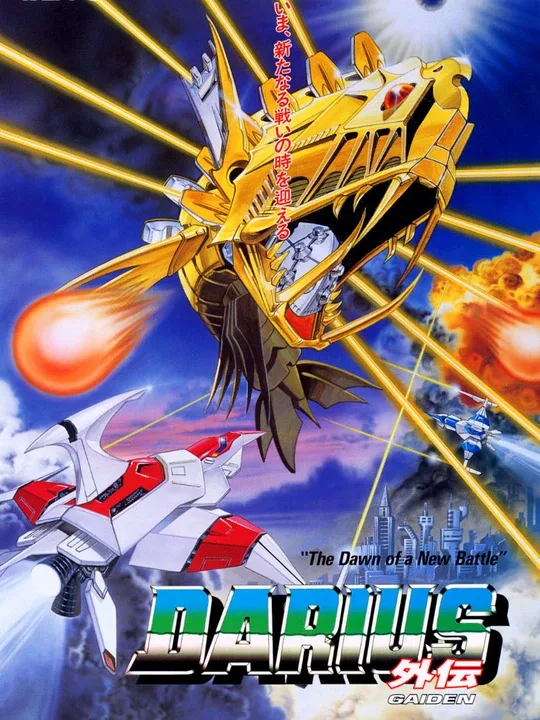
Darius Gaiden

Darius Gaiden

Taito, Acclaim, Interplay

Darius Gaiden is a two-dimensional shoot'em up. The player controls a space ship named the Silver Hawk and must guide it through scrolling stages, destroying enemies and avoiding obstacles along the way. The ship is armed with forward-firing missiles, aerial bombs and a protective force-field, all of which can be upgraded by various power-ups that are dropped by specially-colored enemies when they are destroyed by the player. New to the Silver Hawk's arsenal in Darius Gaiden is the 'black hole bomb.' When fired, the black hole bomb will create a large vortex in the center of the screen, which sucks in enemies and projectiles on the screen for a short moment, until it explodes into a powerful ball of lightning that inflicts massive damage onto every enemy on the screen. Another feature introduced Darius Gaiden is the ability to capture minibosses, who appear in every stage. Each miniboss has a small, circular ball placed on them that, after receiving enough damage, will detach and float away, causing the miniboss to turn idle. If the player collects the ball, the miniboss will follow and aid the player. After a brief period of time, or the player loses a life, the miniboss will explode. A few months following release, update to the arcade version was later released entitled "Darius Gaiden Extra Edition". This version of arcade game contains rearranged levels, as well as automatically-enabled auto fire, two extra weapon power levels (bigger wave shot and a bigger red wave shot as well) and an all-stage mode which can be accessed by starting the game in 2P side.

ArcadeShooter
24 / 28